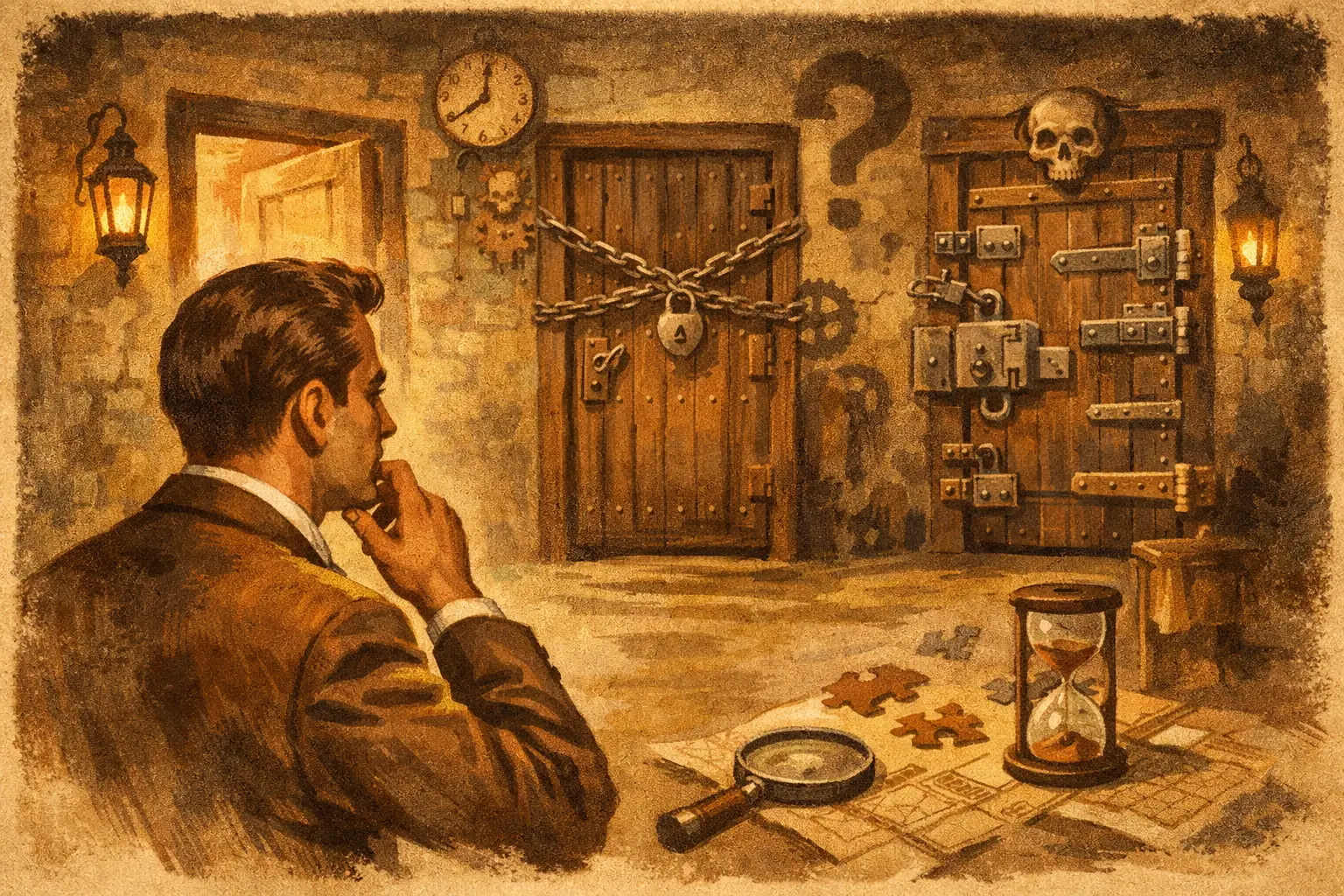
Picking a room that is too easy can feel flat. Picking one that is too hard can turn a fun night into 60 minutes of confused staring at a locked box. If you are wondering how to choose escape room difficulty, the real goal is not choosing the hardest game possible. It is choosing the room that gives your group the best shot at feeling challenged, involved, and fired up from start to finish.
That sweet spot looks a little different for every group. A family with kids, a bachelorette party, a team-building outing, and a couple of puzzle pros should not all book the same way. The best escape room difficulty is the one that matches your people, your mood, and the kind of win you want.
How to choose escape room difficulty for your group
Start with the most important question: who is actually playing? Not who booked it. Not who says they are “good at puzzles.” The full group matters.
If half your team has done ten escape rooms and the other half has never done one, you do not really have an advanced group. You have a mixed group. That usually means choosing a room that has enough challenge to stay exciting, but not so much complexity that newer players get sidelined.
A good escape room should make everyone feel useful. That is why group fit matters more than bragging rights. If one or two players solve everything while everyone else watches, the room may be too advanced for that lineup. On the other hand, if clues are getting solved before the game even gets going, you probably went too easy.
The best choice usually lands right in the middle – enough pressure to create excitement, enough momentum to keep people engaged, and enough solvable moments for everybody to contribute.
Consider experience level honestly
This is where a lot of groups get overconfident. Enjoying true crime shows, board games, or crossword puzzles does not automatically make you escape room experts. Escape rooms test observation, communication, logic, and time management all at once. That is a different kind of challenge.
If your group is brand new, beginner-friendly or moderate difficulty is usually the smarter pick. You will still get plenty of challenge, but the game flow will be easier to understand. First-timers tend to have more fun when they can learn the rhythm of an escape room without getting buried under layers of puzzles right away.
If your group has several successful escapes under its belt, a harder room can make sense. Experienced players often enjoy more complex puzzle chains, less obvious clues, and tighter time pressure. Just make sure everyone in the room wants that kind of intensity. Some people like a challenge. Some people are on vacation and want a fun adventure, not a mental triathlon.
Think about age range, not just age minimums
Age matters for difficulty, but not in a strict, one-size-fits-all way. A room that works well for teens and adults may still be perfect for a family if the younger players can participate in visible, hands-on parts of the game.
The real question is whether the room allows everyone to join the action. Younger players usually do better in rooms with clear visual clues, strong themes, and collaborative puzzle-solving instead of highly abstract logic. Adults-only groups can often handle more layered or subtle challenges, especially if they enjoy strategy and problem-solving.
For mixed-age groups, ask yourself whether the room will let kids feel involved or leave them waiting while adults decode everything. The best family-friendly challenge is one where younger players can spot clues, open compartments, and celebrate wins right alongside the grownups.
Match the room to the reason you booked
Not every group wants the same kind of night. That matters more than people realize.
If you are planning a birthday, family outing, or vacation activity, fun usually beats pure difficulty. A room with a strong theme, fast momentum, and a satisfying challenge often creates the best memories. You want laughs, big moments, and that race-the-clock energy without turning the whole group into stressed-out detectives.
If you are booking for puzzle lovers, returning players, or a competitive group that wants to prove something, then a harder room can be a great fit. These groups often enjoy working for the win. They do not mind a tougher path if the payoff feels earned.
Corporate teams are their own category. For team building, the ideal room is rarely the toughest one on the board. You want communication, collaboration, and shared momentum. If the game is too hard, stronger personalities may take over while quieter teammates disengage. A moderate challenge usually brings out better teamwork because more people can contribute under pressure.
Group size changes difficulty too
This part gets overlooked all the time. The same room can feel totally different depending on whether you bring two people or eight.
Smaller groups often need a room with a cleaner structure and a manageable number of puzzle paths. If a room is designed with lots of simultaneous tasks, a team of two may feel stretched thin. That does not mean small groups need easy rooms. It just means they need rooms that fit their bandwidth.
Larger groups can handle more complexity, but only up to a point. If too many people are packed into a room, communication gets messy and some players end up standing around. A bigger team can make a hard room easier, but it can also create chaos if the game space or puzzle design does not support that many voices.
When choosing difficulty, think about how many active problem-solvers you will have, not just how many tickets you booked.
Read the room description for clues
Difficulty ratings help, but they do not tell the whole story. One company’s “medium” might feel like another company’s “hard.” That is why the room description matters.
Look for signs of what kind of challenge the game offers. A room that emphasizes story, immersion, and adventure may feel more accessible, even if it still has plenty of puzzles. A room described as highly technical, multi-step, or built for experienced players is usually telling you exactly what to expect.
Theme can matter too. People often perform better when they are excited by the setting. If your group loves pirate legends, mysteries, heists, or local adventure vibes, they will usually engage faster and communicate better. That does not make the room easier. It makes your team more locked in.
At Key West Room Escape, for example, the best choice is often the room that fits your group’s energy as much as its skill level. If your team is excited from the second the door closes, you are already off to a better start.
Ask for guidance instead of guessing
If you are unsure, ask. A good escape room staff knows which rooms are better for first-timers, families, competitive adults, and mixed-experience groups. They see players every day. They know where people tend to thrive and where they get stuck.
You do not need to impress anyone by choosing blind. Give a quick snapshot of your group: ages, number of players, how many rooms you have done, and whether you want more fun, more challenge, or a bit of both. That usually leads to a much better recommendation than just picking the highest difficulty and hoping for the best.
This is especially helpful if your group falls into an in-between category. Maybe you have smart first-timers. Maybe you have experienced players bringing kids. Maybe you want a challenge, but not one that turns the room into a debate club with a countdown clock. Staff can help you thread that needle.
The best difficulty is the one that keeps everyone in the game
If you are still deciding how to choose escape room difficulty, forget the idea that harder automatically means better. The best room is the one where your group stays engaged, communicates, gets those big breakthrough moments, and leaves talking about how close it was.
That might be a beginner-friendly room for your first game. It might be a serious challenge for your fifth. It might be a middle-ground room that lets the puzzle lovers stretch while still giving newer players a real chance to crack the code.
Choose for the group you actually have, not the group you imagine. If everybody gets to contribute and every second counts in the best way, you picked the right one.