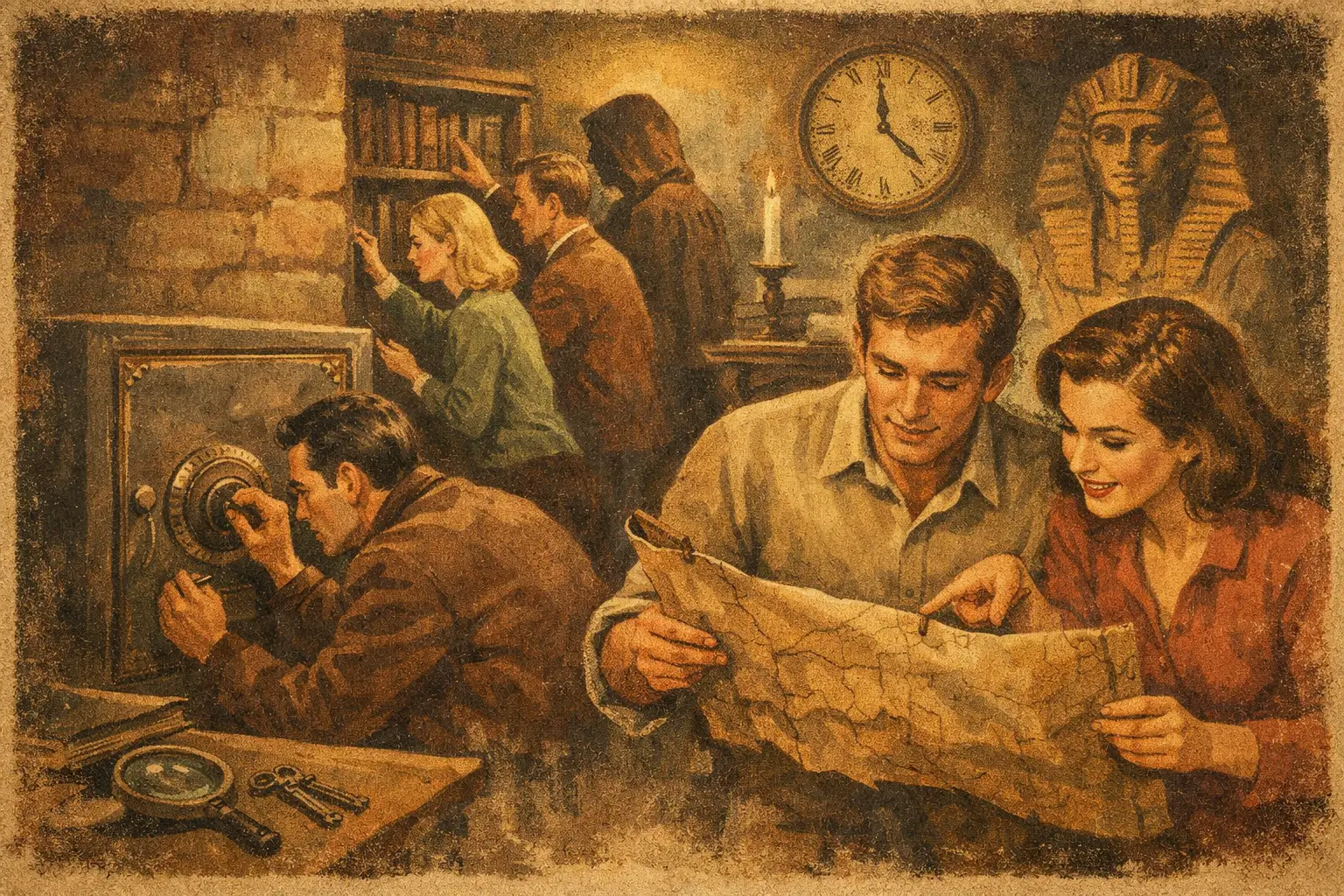
Your group is standing in a pirate’s hideout, a haunted parlor, or another story-filled setting. The clock starts. A strange symbol appears on the wall. Someone finds a key, someone else spots a pattern, and suddenly everybody has an opinion. That is how private escape games work: your crew gets the room to yourselves, then works together to solve the mission before time runs out!
Private games turn a regular outing into a shared adventure. There are no strangers taking over the puzzle table, no wondering whether your group will fit the room’s vibe, and no need to split your attention between your friends and another party. You bring the crew. We bring the clues, surprises, and ticking clock.
What “Private” Really Means
A private escape game is reserved only for the people in your booking. If you book for two people, it is just the two of you. If you bring eight friends for a birthday, all eight players are part of the same team. You will not be paired with another family, couple, or group of tourists to fill open spots.
That matters more than many first-time players expect. Escape rooms are built around communication. Your group needs to call out discoveries, compare ideas, and decide what to try next. In a private game, you can play loudly, laugh at wrong answers, delegate jobs, or spend ten minutes debating a suspicious painting without worrying about people you just met.
It also makes the experience a better fit for celebrations, family vacations, bachelor and bachelorette outings, and team-building events. The game belongs to your group for that scheduled session. Your personalities become part of the story.
How Private Escape Games Work From Booking to Finish
The process is simple, but the fun is in what happens between the first clue and the final lock.
Choose a game and a time
Start by picking an experience that fits your group size, interests, and schedule. Most escape rooms have a recommended player range, often somewhere between two and 10 people. A smaller group may enjoy a more intense challenge where every person handles several puzzles. A larger group brings more eyes and ideas, but it also needs a little organization to avoid everyone crowding around the same lock.
Theme matters, too. A pirate adventure feels different from a mystery, a jailbreak, or a spooky investigation. Choose the story your group will be excited to step into, not just the room with the earliest opening.
When booking, count the people who will actually play. If your group may grow, check the game’s capacity and booking policy before you arrive. Larger school groups and corporate teams may need special scheduling or multiple experiences running at once.
Arrive early enough to get in the game
Escape rooms run on timed sessions, so showing up a few minutes early is a smart move. You may need to complete a waiver, use the restroom, put away personal items, and hear the rules before your mission begins. Arriving at the exact start time can cut into the adventure, and every second counts!
A game guide will explain the basics. You will hear what you can touch, what is off-limits, how hints work, and what to do in the unlikely event that someone needs to leave the room. The goal is not to trick players with confusing rules. It is to make sure everyone can focus on the puzzles safely and confidently.
Enter the story
Once the door closes and the timer begins, the game becomes hands-on. You might search for hidden objects, read a coded message, match symbols, arrange items in the right order, or use a discovery from one puzzle to solve the next. Some clues lead directly to a lock. Others reveal information you will need later.
A well-designed room is not just a pile of padlocks. It is a chain of discoveries tied to a theme. The story gives your group a reason to search a captain’s cabin, inspect an old map, recover a missing artifact, or expose a secret before time runs out.
You do not need trivia knowledge, advanced math, or a genius-level IQ. The strongest escape room teams are usually the ones that stay curious, share information, and keep moving when an idea does not work.
What You Will Actually Be Doing Inside
Players often imagine an escape room as one giant riddle. In reality, it is a mix of different challenge types. One person may be looking for a hidden compartment while another is testing a word puzzle, and a third is organizing found objects on a table.
Expect puzzles that reward observation, logic, pattern recognition, wordplay, teamwork, and occasionally a little physical interaction. You may find a combination lock, but the hard part is rarely opening it. The hard part is figuring out which of the many numbers in the room is the combination.
Communication is your biggest advantage. Say what you find out loud, even if it seems unimportant. A tiny symbol on a postcard may mean nothing to you but solve a puzzle for the teammate working across the room. Keep used clues in one area when possible, and let the group know when a lock or box has already been opened. That prevents the classic escape room moment: three people trying to solve something your teammate finished five minutes ago.
Hints Are Part of the Adventure, Not a Defeat
Most private escape games offer a hint system. Depending on the game, your guide may communicate through a screen, a speaker, a walkie-talkie, or another story-friendly method. If your team is stuck, ask for help.
There is no prize for spending half the game staring at one clue while the clock races away. A good hint should nudge your team back into action rather than hand over the entire answer. Think of it as your game guide keeping the adventure moving.
The right time to request a hint depends on your group. Puzzle veterans may enjoy wrestling with a difficult step longer. Families with younger players or visitors fitting an activity between snorkeling and dinner may prefer a faster pace. Either way, the point is to have a great shared experience, not prove that nobody ever needed a clue.
Private Does Not Mean You Must Be an Expert Team
First-timers sometimes worry that private means they are on their own with no backup. Not at all. You are playing with your own group, but a game guide is still watching the experience and ready to help when needed. You get the privacy of your own team plus the support to keep the game fun.
Private games are especially good for mixed groups. Kids can search for clues and spot details adults overlook. Competitive friends can split into small puzzle squads. Coworkers can practice listening and problem-solving without making the activity feel like a meeting. Couples get a memorable date night with more to do than simply sit across a table.
The trade-off is that a group with very few players has fewer brains working at once. A bigger group may have plenty of ideas but can become chaotic. For many games, four to six players is a comfortable sweet spot, though the best size depends on the room and your crew’s style.
How to Help Your Group Play Better
You do not need a captain, but it helps when somebody keeps an eye on the big picture. If one puzzle is going nowhere, switch players or set it aside temporarily. Fresh eyes are surprisingly effective.
Avoid pocketing clues or silently working alone for too long. Escape rooms reward sharing, and the answer one person sees may only make sense when paired with an object another person found. Also, resist the urge to force anything. If a drawer will not open, it is probably not the right time, code, or mechanism. The room is challenging enough without wrestling the furniture!
Most importantly, let everyone participate. The fastest solver is not always the most valuable player. Someone who notices a color sequence, keeps materials organized, or reminds the team of an earlier clue can change the whole game.
After the Clock Stops
When time runs out or your team completes the final mission, the game guide will usually bring the story to a close and answer questions about anything you missed. Even groups that do not escape often leave talking about the one puzzle that almost had them, the clue hidden in plain sight, or the hilarious theory that sent everyone in the wrong direction.
At Key West Room Escape, that shared post-game energy is part of the point. You have done more than pass an hour indoors. You have chased a mission together, made a few wild guesses, and created a vacation story worth retelling.
Pick a theme your crew will love, arrive ready to communicate, and do not be shy about asking for a hint when the clock gets spicy. Then step inside and see what your group can crack before the final second disappears!