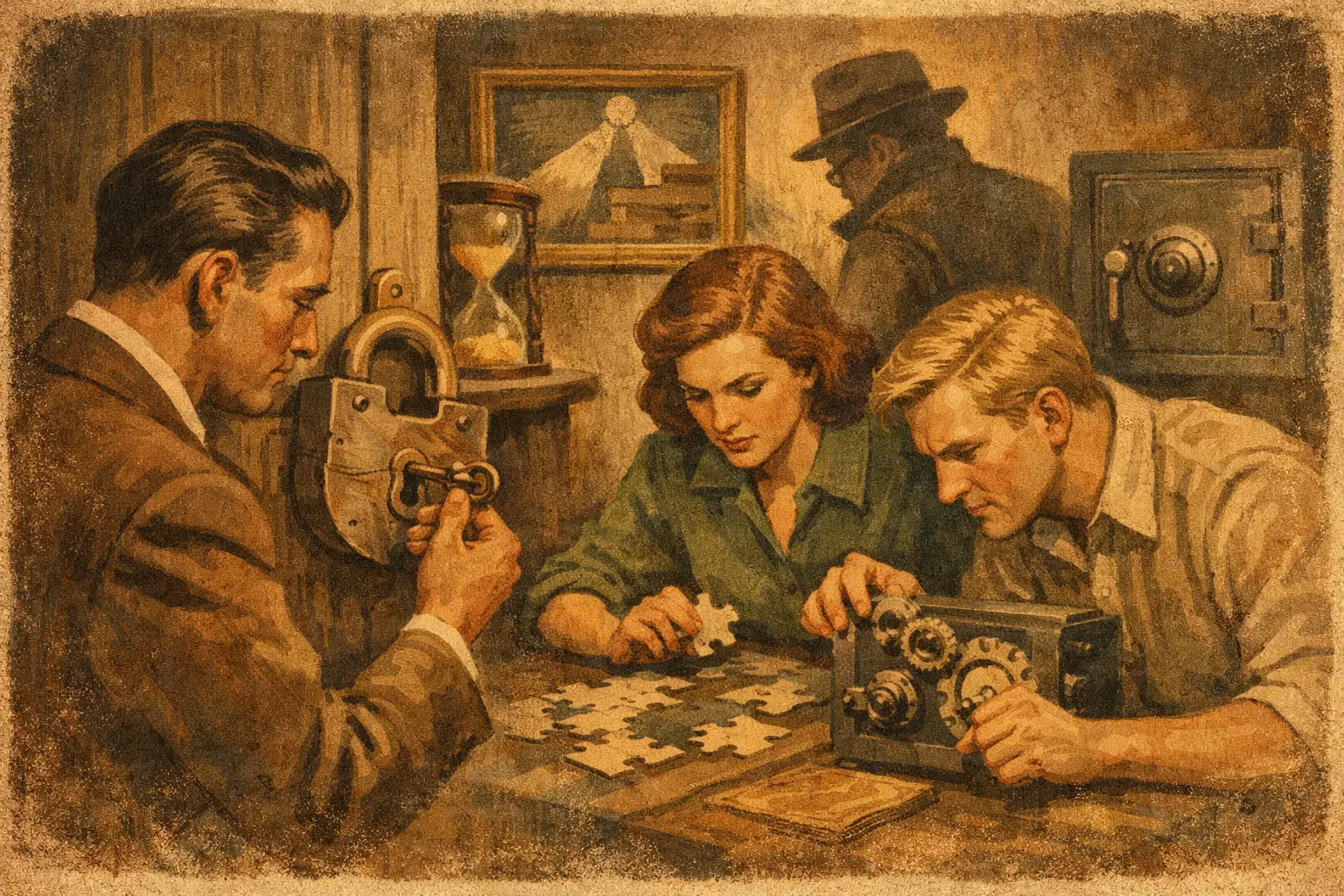
A locked chest, a strange map, three clues that seem unrelated, and a clock that will not slow down. That is where the real escape room problem solving benefits begin. Your group is not just hunting for a key. You are deciding what matters, sharing what you see, testing ideas, and changing course when the first brilliant plan turns out to be completely wrong.
That makes an escape room more than a fun way to spend an hour in Key West. It is a live, hands-on challenge where every player gets a chance to think, contribute, laugh, and help move the mission forward. Whether you are traveling with family, celebrating with friends, or getting coworkers out from behind their screens, the lessons tend to stick because the experience is shared.
Escape Room Problem Solving Benefits in Action
Most everyday problems arrive one piece at a time. An escape room tosses the whole pile onto the table at once. There may be a coded note, a hidden compartment, a symbol that appears on a painting, and a lock with five possible combinations. The trick is not to solve everything at once. It is to organize the chaos.
Players quickly learn to sort information into useful categories: clues that have already been used, puzzles that still need attention, objects that might connect, and details that are probably just there to set the scene. This is practical problem solving. It rewards observation and logic, but it also rewards the simple habit of keeping the group from doing the same work twice.
The time limit adds just enough pressure to make decisions matter. You cannot spend 20 minutes defending one theory because it feels clever. If it is not working, the team needs to recognize that, regroup, and try another route. That willingness to adjust is useful far beyond a game room.
You Practice Seeing More Than One Answer
Many escape room puzzles are designed to challenge the first assumption. A number may be part of a date, a directional code, a sequence, or a clue that tells you where to look next. A key might open a lock, but it could also reveal a message, trigger a mechanism, or point toward a bigger pattern.
That is why escape rooms build flexible thinking. Players become more comfortable asking, “What else could this mean?” instead of stopping at the first explanation. For teens and adults alike, this is a valuable habit. School assignments, work projects, travel hiccups, and family plans rarely come with a single obvious solution.
There is a trade-off, of course. Too much second-guessing can slow everyone down. Great teams know when to explore possibilities and when to test an idea quickly. In an escape room, testing is usually better than debating. Try the code. Match the symbols. Check the drawer. If it fails, you have learned something and can move on.
Communication Stops Being Optional
A player finds a tiny compass tucked behind a book. Another discovers a wall chart covered in directions. A third has been holding a note with strange coordinates for five minutes. None of those clues help much until someone says what they found.
Escape rooms make communication visible. Groups notice right away when people keep discoveries to themselves, talk over one another, or assume someone else has handled a puzzle. They also see how fast momentum builds when teammates call out clues clearly and listen to responses.
The best communication is not always the loudest. A quiet player may spot the detail everyone else missed. Someone who does not love math may be excellent at noticing color patterns. Another person may be the organizer who keeps track of which locks have been tried. The goal is not for one person to be the hero. The goal is to make sure useful information reaches the whole crew.
For corporate groups, that can be a surprisingly honest lesson. Job titles fade away when the pirate chest will not open. A good idea is a good idea, whether it comes from the manager, the newest employee, or the person who initially said, “I am just here for the snacks.”
Pressure Builds Calm, Not Panic
Every second counts, but the best escape room teams do not sprint around the room in a panic. They develop a rhythm. One or two players search for new clues. Others work on active puzzles. Someone makes sure the team shares discoveries. When a challenge stalls, they call for fresh eyes.
This is a small-scale version of handling pressure without letting it take over. The countdown creates urgency, yet the group has to stay organized enough to think. Players learn that rushing is not the same as moving quickly.
Families often see this benefit in a particularly fun way. Kids may jump into the search with fearless energy, while adults bring patience and context. Sometimes the kids notice what the adults walk right past. Sometimes an adult helps turn a wild idea into a workable plan. Those roles can flip several times in 60 minutes, which is part of the magic.
Failure Becomes Useful Information
A wrong combination can feel frustrating for about three seconds. Then it becomes a clue. Maybe two of the numbers are correct but in the wrong order. Maybe the lock belongs to a different object. Maybe the group solved the right puzzle using the wrong piece of information.
Escape rooms offer a low-stakes place to get comfortable with being wrong. That matters because strong problem solvers do not avoid mistakes at all costs. They notice mistakes, learn from them, and make the next attempt better.
This is especially helpful for groups with perfectionists. In a timed game, nobody has the luxury of waiting for a flawless plan. Progress often comes from making a reasonable guess, checking the result, and revising. It is a better lesson than pretending the answer should always appear fully formed.
Shared Wins Build Real Connection
The most memorable moments are rarely about who solved the most puzzles. They are about the instant someone shouts, “Wait, I know what this means!” and the whole group races over. They are about a family cracking the last code together, friends celebrating a hidden-door reveal, or coworkers realizing they are much better as a team than they expected.
A shared challenge creates stories people retell. That is why an escape room works so well for vacation days, birthdays, bachelor and bachelorette outings, and team events. Everyone is active. Nobody is stuck watching from the sidelines. And even if your group does not escape, you still leave with the same favorite question: “How did we miss that?”
At Key West Room Escape, the local setting adds another layer to the experience. Pirate lore, island mystery, Old Town energy, and a little bit of tropical mischief give groups something more memorable than a generic rainy-day activity. You are not simply solving puzzles. You are stepping into a story and trying to outsmart it before time runs out.
How to Get More From the Experience
You do not need to be a puzzle expert to benefit from an escape room. In fact, groups do best when they arrive ready to participate instead of waiting for the “smart person” to take charge. Search carefully, say what you find, and be willing to hand a puzzle to someone else if you hit a wall.
Before the game starts, agree on one simple rule: no clue stays private. Put useful objects in a central spot, announce important discoveries, and tell the group when a lock or puzzle has already been attempted. Those small habits prevent confusion and free up more time for the fun parts.
It also helps to keep expectations realistic. Escape rooms reward teamwork, not trivia knowledge. You may breeze through a difficult cipher and get stuck on a simple visual clue. Another group may do the opposite. Success depends on the room, your group size, how well people communicate, and whether everyone stays engaged.
The biggest win is not always the final escape. It is watching your group shift from scattered guesses to a real team with a plan. So gather your crew, crack the code, and give everyone a chance to bring one crucial piece of the puzzle to the table!