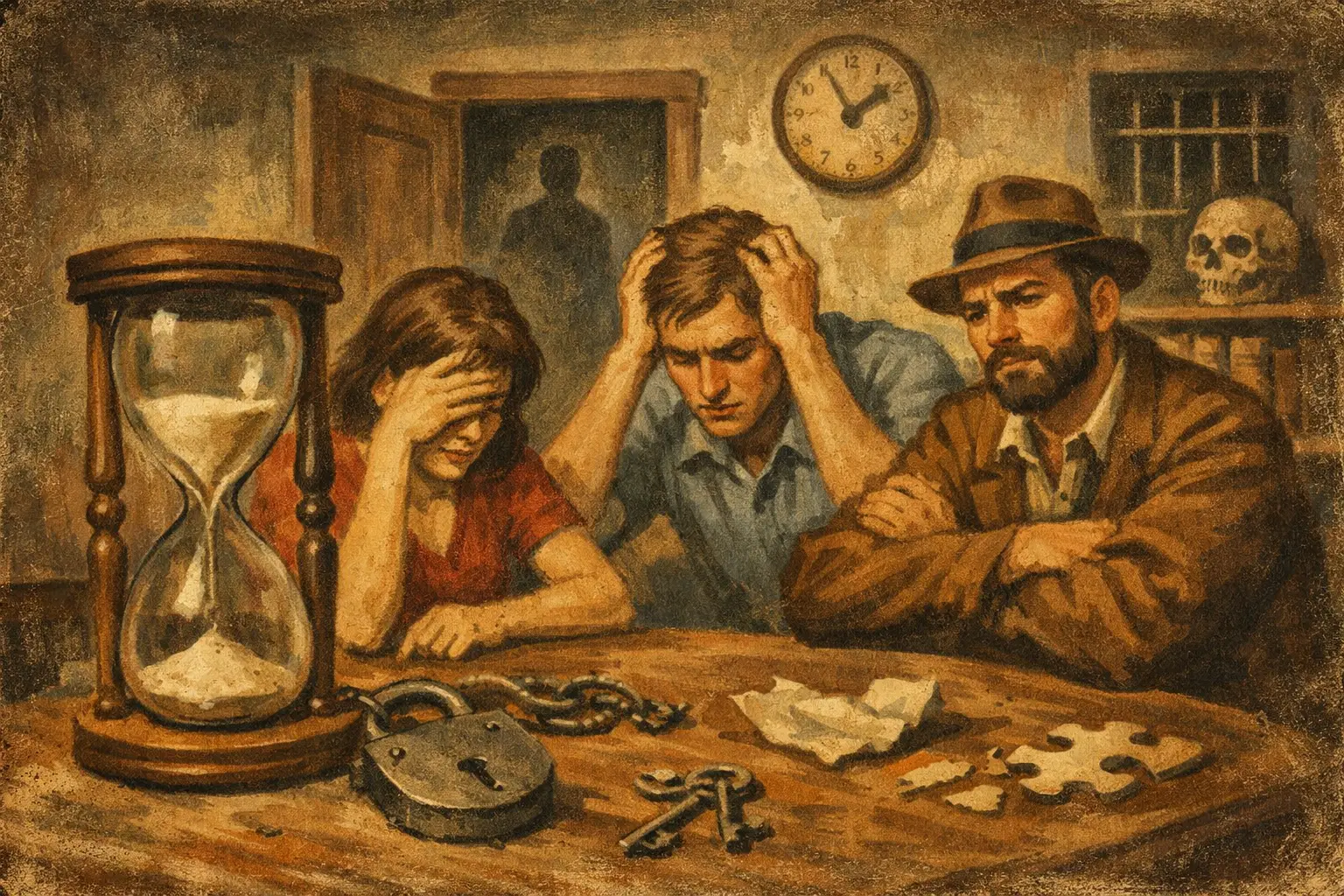
The clock flashes 00:00. Your team has one lock left, three suspicious objects on the table, and someone is still convinced the parrot was a clue. So, what happens if you lose escape room games? Nothing bad, nothing embarrassing, and definitely nothing that ruins the fun. You get the ending, you get to see what you missed, and you leave with a story your crew will be retelling over dinner.
Escape rooms are built around the thrill of trying to beat the clock, but the experience is much bigger than a win or loss. The real prize is the frantic teamwork, surprise discoveries, hilarious wrong turns, and that one moment when a puzzle finally clicks. Every second counts, but a loss is not a failure. It is simply the final chapter of your adventure.
What Happens If You Lose an Escape Room?
When time runs out, the game does not suddenly stop with no explanation. Your game guide will usually step in, reveal the solution to the final puzzle or puzzles, and walk your group through the ending you were racing toward. If you were one step away, you will know it. If you were chasing the wrong idea entirely, you will know that too – and it often makes for the best laugh of the day.
In most escape room experiences, you are not locked in for real. The door is not a punishment, and losing does not mean you are stuck inside until somebody finds the secret emergency banana. You can leave if needed, and the game is designed to be safe, guided, and fun from start to finish.
You may also get a chance to snap a team photo, compare your progress with the room’s success rate, and hear which puzzles tend to stump other groups. That post-game reveal is part of the experience. It turns a near miss into a satisfying answer instead of a mystery that follows you around Old Town all afternoon.
Losing Can Still Feel Like a Great Finish
A good escape room ending should feel earned, even when the clock wins. You may not have completed every challenge, but you have spent an hour making decisions together under pressure. That means you have already done the part that makes escape rooms memorable.
Maybe your family discovered that Grandma is a secret codebreaker. Maybe the quiet person on the bachelor party team noticed the tiny detail everyone else ignored. Maybe your coworkers learned that shouting five different ideas at once is not, technically, a communication strategy. A loss can reveal just as much about a group as a win.
There is also a big difference between losing badly and coming heartbreakingly close. If your team had the final code in hand but ran out of time before entering it, you were not “bad” at the game. You were one fast connection away from victory. That is exactly why people come back to try another room.
Even teams that are nowhere near the final puzzle usually walk away with favorite moments. Escape rooms are packed with mini-wins: opening a hidden compartment, spotting a pattern, solving a riddle, or connecting clues that looked completely unrelated five minutes earlier. Those victories still count.
Does Losing Affect Your Group’s Experience?
Only if your group decides it does. For most vacationers, friends, families, and team-building groups, the goal is a shared adventure, not a perfect record. Winning is exciting, of course. Hearing that final lock pop open with seconds left is a fantastic feeling. But treating the game like a high-stakes test can make people freeze up, argue over every clue, or stop having fun.
The best teams stay curious. They share what they notice, listen when someone has a different idea, and ask for help before frustration takes over. That approach improves your odds, but it also makes the hour more enjoyable whether you escape or not.
For corporate groups, a loss can even spark a useful conversation afterward. Did everyone have a chance to speak? Did the team divide tasks well? Was someone holding onto a clue that another person needed? No lecture required – just a little friendly reflection while the adrenaline is still high.
For families, losing can be a great reminder that everyone contributed something. A child may have spotted a color sequence that adults overlooked. A parent may have organized scattered information into one clear plan. Escape rooms reward different kinds of thinking, which is why a mixed-age group can be surprisingly powerful.
Why Teams Run Out of Time
The clock is part of the challenge, so even sharp groups can lose for totally normal reasons. A room may have a puzzle style your team has not seen before. You may spend too long on a clever red herring. Or you may solve a difficult clue but fail to communicate the answer across the room.
Some teams rush through the opening and miss important details. Others inspect every inch of the room so carefully that they burn ten minutes debating whether a decorative shell is secretly part of a pirate conspiracy. Both approaches are understandable. The sweet spot is paying attention without overthinking every prop.
Group size matters too. A pair may communicate easily but have fewer eyes searching for clues. A larger group has more brainpower, but it can become crowded or noisy if everyone works on the same puzzle. The best move is to split up when there are clear tasks, then regroup often to share discoveries.
Difficulty can vary as well. Some rooms are designed to be friendly for first-timers, while others ask for stronger puzzle instincts, tighter communication, or more experience managing a countdown. A challenging game is not unfair just because it beats you. Sometimes the room wins fair and square.
How to Give Your Team a Better Shot Next Time
You do not need to become professional puzzle pirates to improve. Start by saying every discovery out loud. If you find a key, a number, a symbol, or an unusual object, tell the group immediately. Information trapped in one person’s head is information the team cannot use.
Keep used clues organized in one area and unsolved items in another. This prevents the classic escape room problem: someone tries to use a clue that was already solved fifteen minutes ago, and suddenly everyone is backtracking. A simple clue table can save precious minutes.
When a puzzle is not moving, switch players. Fresh eyes are powerful. The person who has stared at a lock for five minutes may be too locked into one idea to see the obvious answer. Let someone else take a look while you tackle something new.
Use hints strategically. Hints are not cheating. They are a tool to keep your adventure moving, especially when your group has hit a genuine dead end. Waiting too long for a breakthrough can cost more time than asking for a small nudge. A good hint should point you back toward the path without solving the whole game for you.
Most of all, do not let one stubborn puzzle become the villain of the hour. If it is not clicking, move on. There may be another clue elsewhere that makes everything make sense.
The Win Is the Story You Take With You
At Key West Room Escape, the goal is not to make anyone feel defeated. The goal is to put your crew inside an adventure where the clues matter, the pressure is real enough to be exciting, and everybody has a chance to shine. Some teams escape with moments to spare. Others get a dramatic reveal after time expires. Both groups usually walk out smiling.
So if the clock beats you, ask to see the solution, take the team photo, and give yourselves credit for the puzzles you cracked along the way. Then carry the story into the rest of your Key West day: the code you almost solved, the clue nobody noticed, and the teammate who was absolutely certain the parrot was involved.