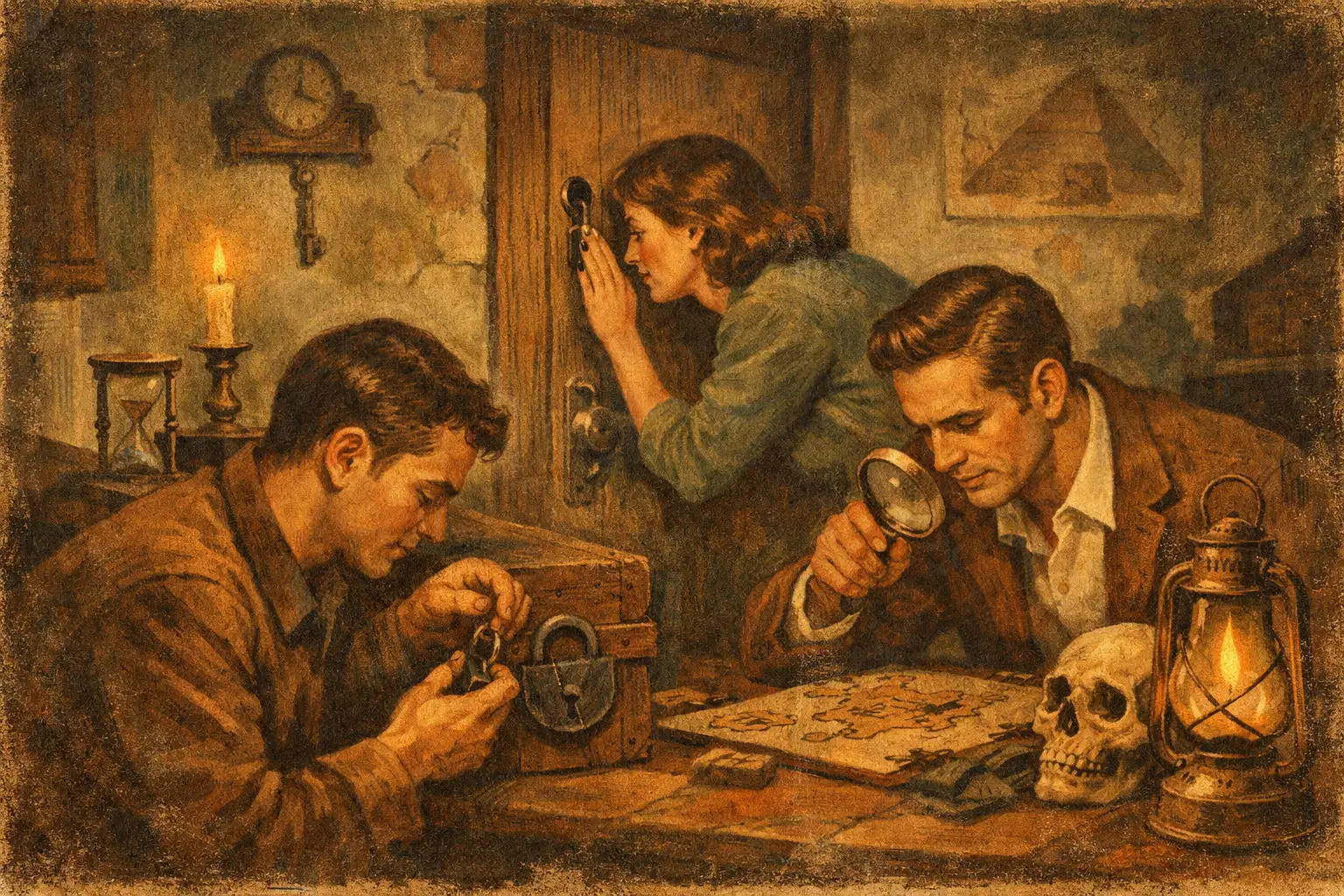
You can only sit on the beach for so long before someone in the group says, “Okay, what are we doing tonight?” That is exactly where the purpose of escape rooms starts to make sense. They are not just games for puzzle lovers. They are a fast, memorable way to turn a regular outing into a shared mission where everyone has something to do, every second counts, and the story pulls your whole group in.
The real purpose of escape rooms
At the most basic level, the purpose of escape rooms is to entertain people through live, interactive problem-solving. But that answer is too small for what actually happens inside the room. A good escape game gives your group a challenge, a deadline, and a reason to work together. That combination changes the energy right away.
Instead of watching something happen, you are in it. Instead of splitting off into little side conversations, your group starts swapping clues, checking locks, spotting patterns, and celebrating small wins. The room gives everybody a common goal, which is why escape rooms feel more social than a movie and more structured than just wandering around town looking for something to do.
That is a big part of their appeal for tourists, families, friend groups, and work teams. People want an activity that feels active without being exhausting, exciting without being complicated, and fun without needing everyone to like the exact same thing. Escape rooms hit that sweet spot.
Why escape rooms work so well for groups
A lot of activities are fun for one or two people but get awkward once the group gets bigger. Escape rooms are built for the opposite. Their whole design depends on participation.
They give everyone a role
One person notices hidden objects. Another catches wordplay. Someone else is great at staying calm under pressure. Even the friend who swears they are “bad at puzzles” often ends up being the one who spots the clue everybody missed. That is one of the best answers to the question, what is the purpose of escape rooms? They create a space where different personalities and strengths actually help the group.
This matters because shared fun is better when nobody feels like a spectator. In a strong escape room, the challenge is layered enough that people can contribute in different ways. You do not need to be a genius. You need to pay attention, communicate, and be willing to jump in.
They create instant teamwork
Most groups do not need more small talk. They need something to do together. Escape rooms cut past the usual social warm-up and drop everybody into action. The timer starts, clues are waiting, and now your group has a mission.
That is why they work so well for birthdays, family outings, double dates, bachelor and bachelorette groups, and corporate events. You are not forcing connection. The room creates it naturally.
They feel like an event, not just a time filler
People remember escape rooms because they are participatory. There is a difference between saying, “We went out,” and saying, “We had 12 minutes left, found the missing key, and barely cracked the final code!” One is a plan. The other becomes a story.
The purpose of escape rooms goes beyond puzzles
If you have never tried one, it is easy to assume escape rooms are only about logic problems. Puzzles are part of it, sure, but they are not the whole point.
They deliver immersion
The best rooms put you inside a theme instead of just handing you a worksheet with locks. Maybe you are solving a mystery, chasing pirate treasure, or trying to outsmart a villain. The setting matters because it gives the challenge personality.
That sense of immersion is a huge reason people choose escape rooms over more ordinary group activities. The room feels like a mini adventure. In a place like Key West, where visitors are already looking for memorable experiences, that kind of themed entertainment fits right in.
They make problem-solving fun
Real-life problems usually come with stress, confusion, and no satisfying buzzer at the end. Escape room problems are different. They are designed to be challenging in a fun way. You get pressure, but it is playful pressure. You get difficulty, but with momentum.
That is what makes the experience satisfying. Your group moves from confusion to progress, then from progress to momentum. Every solved clue gives you a little jolt of energy. It is one of the few activities where thinking hard is actually part of the fun.
They offer a break from passive entertainment
A lot of leisure time is passive. You watch, scroll, sit, or listen. There is nothing wrong with that, but sometimes a group wants something that feels more active and memorable. Escape rooms ask people to participate fully. You are moving, searching, talking, and reacting.
That active engagement is part of the purpose of escape rooms, especially for people who want an experience that feels more exciting than dinner reservations and more interactive than sightseeing.
Why people choose escape rooms on vacation
Vacation time is valuable. Nobody wants to waste an evening on an activity that feels generic or forgettable. That is why escape rooms are such a smart pick for travelers.
They are weather-proof, group-friendly, and easy to fit into a day packed with other plans. If the sun has worn everybody out, or the group wants a break from bars, shopping, and the usual tourist stops, an escape room gives you a different kind of energy. It is indoors, organized, and packed with action.
There is also a practical side. Vacation groups often include different ages and personalities. Some people want adventure. Some want air conditioning. Some want a challenge. Some just want to laugh and do something new. Escape rooms work because they can satisfy all of that at once.
When the experience has local flavor, even better. A room or puzzle adventure tied to Key West history, pirate lore, or island character feels more connected to the trip than a generic activity you could do anywhere.
Escape rooms for team building, and when they help most
Corporate groups often ask about the purpose of escape rooms because they want more than entertainment. They want a team activity that reveals how people communicate.
Escape rooms can do that well. They show who listens, who leads, who stays organized, and who notices details. They also create low-stakes pressure, which is useful. Teams have to share information, avoid talking over one another, and adjust when a plan is not working.
That said, not every escape room is automatically a great team-building exercise. It depends on the room design, the size of the group, and the goal. If the challenge is too hard, people can get frustrated. If the group is too large for the space, some participants may feel left out. If the team expects a formal workshop, an escape room will feel more like recreation than training.
The sweet spot is when a team wants a practical, high-energy shared activity that encourages communication without making everyone sit through another conference room exercise. That is where escape rooms shine.
Are escape rooms just for puzzle experts?
Not at all, and that misconception stops some people from trying them. The purpose of escape rooms is not to prove who is smartest. It is to create a fun challenge that rewards curiosity, observation, teamwork, and momentum.
Some players are excellent at riddles. Others are better at spotting physical clues or keeping track of what has already been tried. Most rooms are designed so groups can make progress by combining different skills, not by relying on one person to carry the whole game.
There is also a difference between a hard room and an enjoyable room. A well-designed experience should make players feel challenged, not shut out. The best games build confidence as you go. Even when your group gets stuck, there is still excitement in the process.
What makes the experience worth it
People do not book escape rooms just to beat a clock. They book them because they want that mix of suspense, laughter, urgency, and shared victory. Even near-misses can be fun when the game is designed well and the group is all in.
That is why businesses like Key West Room Escape attract such a wide range of players. Families want an activity everyone can join. Friends want something more memorable than another casual night out. Visitors want a story to take home. Teams want a challenge that gets people working together fast.
The purpose of escape rooms, really, is to turn time together into something more active, connected, and unforgettable. They give groups a reason to focus on one another, think on their feet, and have a blast doing it. If your crew is looking for something that feels like an adventure instead of another way to pass the time, that is a pretty good place to start.